Corporate debt
Lending to a company rather than a state. No taxing power behind it, so the analysis is entirely about the business.
The invention
The problem. Enterprises needed more capital than their owners had, without surrendering ownership.
The VOC issued bonds alongside shares, but the modern corporate bond market was built by 19th-century American railroads, which needed enormous sums to lay track through territory producing no revenue yet. The rating agencies were founded to referee exactly that question.
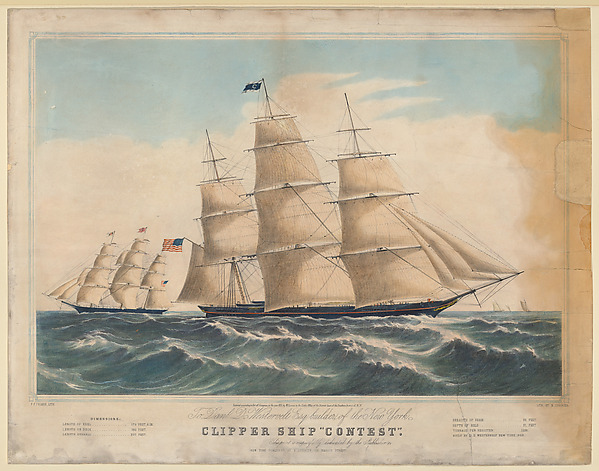
Clipper Ship "Contest"
1853 · The Metropolitan Museum of Art · CC0

[Railroad construction on the City Point and Army railroad line]
1861-01-01 · Library of Congress · Public domain
Where it has failed
Not a list of disasters. A pattern library.
- 1873Philadelphia
Jay Cooke and the railroad bust
The failure of a major railroad financier triggered a panic and a depression lasting years.
Infrastructure debt is a bet that demand arrives before the interest does. Sometimes it does not.
- 2001Houston
Enron's bonds
Investment-grade rated weeks before bankruptcy, leaving bondholders with pennies.
A rating is an opinion produced by a firm paid by the issuer. Treat it as one input rather than a fact.
- 2020United States
The Fed buys corporate bonds
In March 2020 the Federal Reserve announced corporate bond purchases for the first time, halting the selloff almost immediately.
Central bank backstops now extend to private credit. That changes the risk you are actually holding, in ways not yet fully tested.
Where it stands today
You now have the shape. Here is the reading.
Live from public data, pulled at request time. Read it with the failures above in mind — not because a repeat is due, but because knowing the mechanism is what lets you recognise one early.
Federal funds rate
Federal Reserve via FRED
No data returned
FRED (St. Louis Fed) needs FRED_API_KEY in your environment. It is free to obtain — see the sources screen for the link.
Federal Reserve via FRED
In your ledger
If you hold a bond fund, you own this. Its behaviour in a crisis differs from government debt in exactly the way the 2020 episode illustrates.
See it in the demoKeep reading