Currency
A token everyone agrees to accept. Its entire value rests on that agreement holding.
The invention
The problem. Weighing and assaying metal at every transaction was slow and invited cheating.
Lydian kings stamped standardised electrum lumps with a royal mark, converting a commodity into a countable unit. The stamp was the invention: it moved trust from the metal to the issuer. Every currency crisis since has been the moment that transfer was questioned.
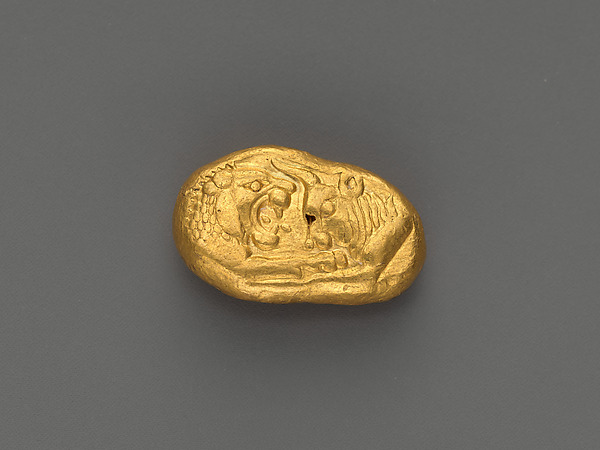
Gold stater
ca. 560–546 BCE · The Metropolitan Museum of Art · CC0
Artifact unavailable
Emergency banknote
The National Numismatic Collection holds notgeld and Weimar hyperinflation issues.
Where it has failed
Not a list of disasters. A pattern library.
- 1023Song China
The first government paper money
Jiaozi began as merchant receipts and were taken over by the state. Later Yuan issues were printed past their backing and collapsed.
Paper money is a thousand years old and has failed repeatedly. The mechanism never changes: issuance outrunning the reason to accept it.
- 1921–1923Weimar Germany
Hyperinflation
Prices doubled roughly every two days at the peak. Mark-denominated savings became worthless.
Currency destruction is a wealth transfer from savers to debtors. It does not feel like a market event; it feels like everything costing more.
- 1971Washington
The gold window closes
The US ended dollar convertibility to gold; the world moved to floating fiat within two years.
The monetary system every living person treats as normal is younger than most of their parents. It is an arrangement, and arrangements change.
- 2008–Zimbabwe, Venezuela, Lebanon, Argentina
The pattern continues
Four currency collapses in two decades, each following deficit, monetisation, capital flight, abandonment.
Not a historical curiosity. It is happening somewhere now, and the people it happens to were not more foolish than you.
Where it stands today
You now have the shape. Here is the reading.
Live from public data, pulled at request time. Read it with the failures above in mind — not because a repeat is due, but because knowing the mechanism is what lets you recognise one early.
USD to EUR
European Central Bank via Frankfurter
0.86
Sep 9 · +0.8% y/y
CPI, all items
U.S. Bureau of Labor Statistics via FRED
No data returned
FRED (St. Louis Fed) needs FRED_API_KEY in your environment. It is free to obtain — see the sources screen for the link.
U.S. Bureau of Labor Statistics via FRED
In your ledger
Inflation is currency risk arriving slowly. It is why this app scales your historical spending days rather than assuming last year's groceries cost what they cost.
See it in the demoKeep reading