Grain
The original commodity. Storable, weighable, and the thing every other price was once quoted against.
The invention
The problem. Harvests arrive once; hunger arrives daily.
Grain was the first thing warehoused, the first thing lent, and the first thing whose future delivery was contracted. Egyptian granary receipts circulated as money. Every commodity market since is a variation on the problem of a harvest arriving all at once against demand that does not.

Wheat Fields
ca. 1670 · The Metropolitan Museum of Art · CC0
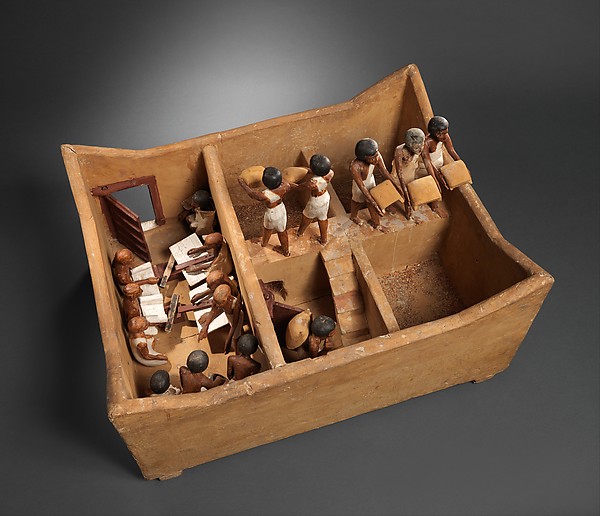
Model of a Granary with Scribes
ca. 1981–1975 B.C. · The Metropolitan Museum of Art · CC0
Where it has failed
Not a list of disasters. A pattern library.
- 1315–1317Northern Europe
The Great Famine
Successive wet years destroyed harvests; grain prices multiplied and millions died.
Commodity prices are a physical constraint expressed in numbers. A price spike in food is not an abstraction to most of the world.
- 1972Soviet Union and United States
The Great Grain Robbery
The USSR quietly bought a large share of the American wheat crop; prices roughly doubled and fed into the decade's inflation.
Information asymmetry in a physical market moves prices before anyone can react. Somebody always knows first.
- 2007–2008Global
The food price crisis
Rice and wheat spiked on export bans, biofuel demand, and energy costs, triggering unrest in dozens of countries.
Commodity shocks propagate into political instability faster than into financial markets.
Where it stands today
You now have the shape. Here is the reading.
Live from public data, pulled at request time. Read it with the failures above in mind — not because a repeat is due, but because knowing the mechanism is what lets you recognise one early.
CPI, groceries
U.S. Bureau of Labor Statistics via FRED
No data returned
FRED (St. Louis Fed) needs FRED_API_KEY in your environment. It is free to obtain — see the sources screen for the link.
U.S. Bureau of Labor Statistics via FRED
In your ledger
Groceries are the largest discretionary line in most ledgers, and they are downstream of this market with a lag of months.
See it in the demoKeep reading