Shares
A divisible, permanent claim on a company's future profits. Younger than most people assume.
The invention
The problem. Voyages to Asia took years and might not return. No merchant could absorb that risk, and per-voyage partnerships dissolved before the next ship sailed.
The Dutch East India Company issued shares that did not expire when a voyage ended — permanent capital, transferable to anyone. Within days a secondary market appeared and Amsterdam had the first stock exchange. The oldest surviving certificate, issued to a merchant named Pieter Harmensz, is a receipt for an idea that reorganised the world.
Artifact unavailable
Dutch East India Company share — the first publicly traded stock
The VOC share of 1602 is the founding document of the equity market.
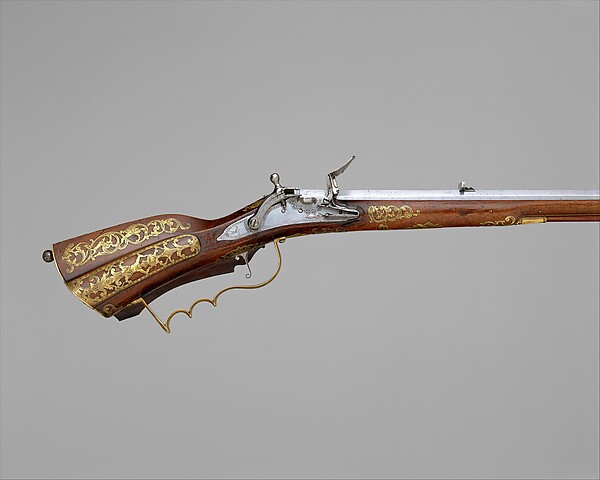
Snaphaunce Hunting Rifle
dated 1722 · The Metropolitan Museum of Art · CC0
Where it has failed
Not a list of disasters. A pattern library.
- 1637Dutch Republic
Tulip mania
Bulb contracts traded at multiples of a craftsman's annual income, then collapsed within weeks.
The first speculative mania arrived within a generation of the first stock market. Recency never explains a bubble.
- 1720London and Paris
South Sea and Mississippi
Two schemes to swap government debt for company shares inflated and burst in the same year.
When a state and a speculative company are entangled, the state has an incentive to keep the story going.
- 1929–1932New York
The Great Crash
US equities fell roughly 89% peak to trough and did not regain the 1929 nominal high until 1954.
Twenty-five years to recover. Any plan whose worst case is a few bad years has not looked far enough back.
- 1990–Tokyo
The Nikkei's long wait
Japan's index peaked in late 1989 and took more than three decades to return to that level.
'Stocks always recover' describes a specific market over a specific window. The counterexample is a G7 economy.
Where it stands today
You now have the shape. Here is the reading.
Live from public data, pulled at request time. Read it with the failures above in mind — not because a repeat is due, but because knowing the mechanism is what lets you recognise one early.
S&P 500
Stooq
No data returned
Stooq returned no usable observations
Stooq
Total US market (VTI)
Stooq
No data returned
Stooq returned no usable observations
Stooq
In your ledger
Equity reaches a household budget only when something is sold, which is why this app models a drawdown as a change in runway rather than in cash.
See it in the demoKeep reading